Beneath the Stratum Corneum, Beyond the Gut Barrier
How a pharmaceutical drug-delivery scientist turned carrier technology into cosmetic and nutraceutical ingredients — Binotec's nano-delivery platforms, read through three US patents
"Patented nano-delivery technology" has long been a routine line in cosmetic ingredient catalogues, and buyers' questions have become correspondingly specific: which patents, how small are the particles and how much do they carry, and has any of it been measured in human skin or human blood?
Binotec Co., Ltd. (CEO Yu Mi Kim), which opened a GMP plant in Gyeongsan, North Gyeongsang Province, last September, is one of the few companies able to answer all three on paper. This report draws on the company's English technical catalogue, US and European patent records, a human clinical paper in an international journal, and finished-product test reports reviewed by our editorial team.
Origins in a pharmaceutical laboratory
Binotec's technology grew out of pharmaceutical drug-delivery research — packaging an active compound in a carrier so that it reaches its target before it is degraded or cleared. CEO Yu Mi Kim trained at Georgia Tech and completed post-doctoral work at Kyungpook National University's dental school before developing carriers as a principal researcher at CJ CheilJedang's pharmaceutical research institute; her work in the field spans 25 years. Founded in 2014 as Celize Cosmetic and renamed Binotec in 2018, the company chose to apply those principles to cosmetic actives and food ingredients.
The problem it addresses is simple to state. Skin is guarded by the stratum corneum; the gut filters out compounds that do not dissolve well in water. However high the loading of an active in a formula, the amount reaching the target layer is often far lower. Binotec addresses the two barriers with two distinct carrier families.
"The value of a delivery technology lies not in how much of an active you can load, but in how precisely it arrives." — Yu Mi Kim, CEO, Binotec
Transdermal delivery: Hydroethosome® and five derivative carriers
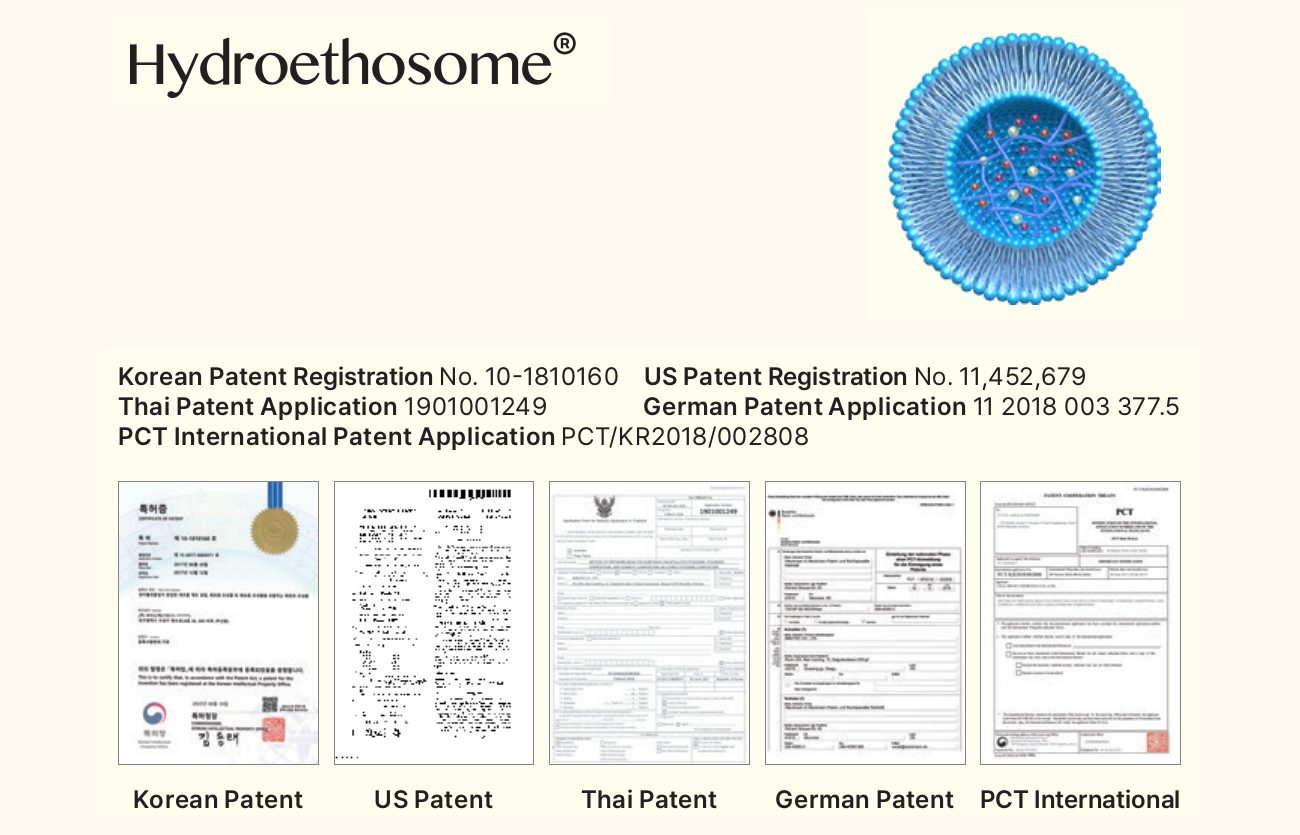
Hydroethosome® encapsulates an active together with a hydrogel inside nano-scale lipid vesicles (ethosomes) and carries it into the skin. Patented in Korea in 2017 (KR 10-1810160), it was granted a US patent in September 2022 (US 11,452,679 B2) and has been filed in Thailand and Germany via PCT. The company credits the hydrogel with raising both the stability and the encapsulation rate of the payload.
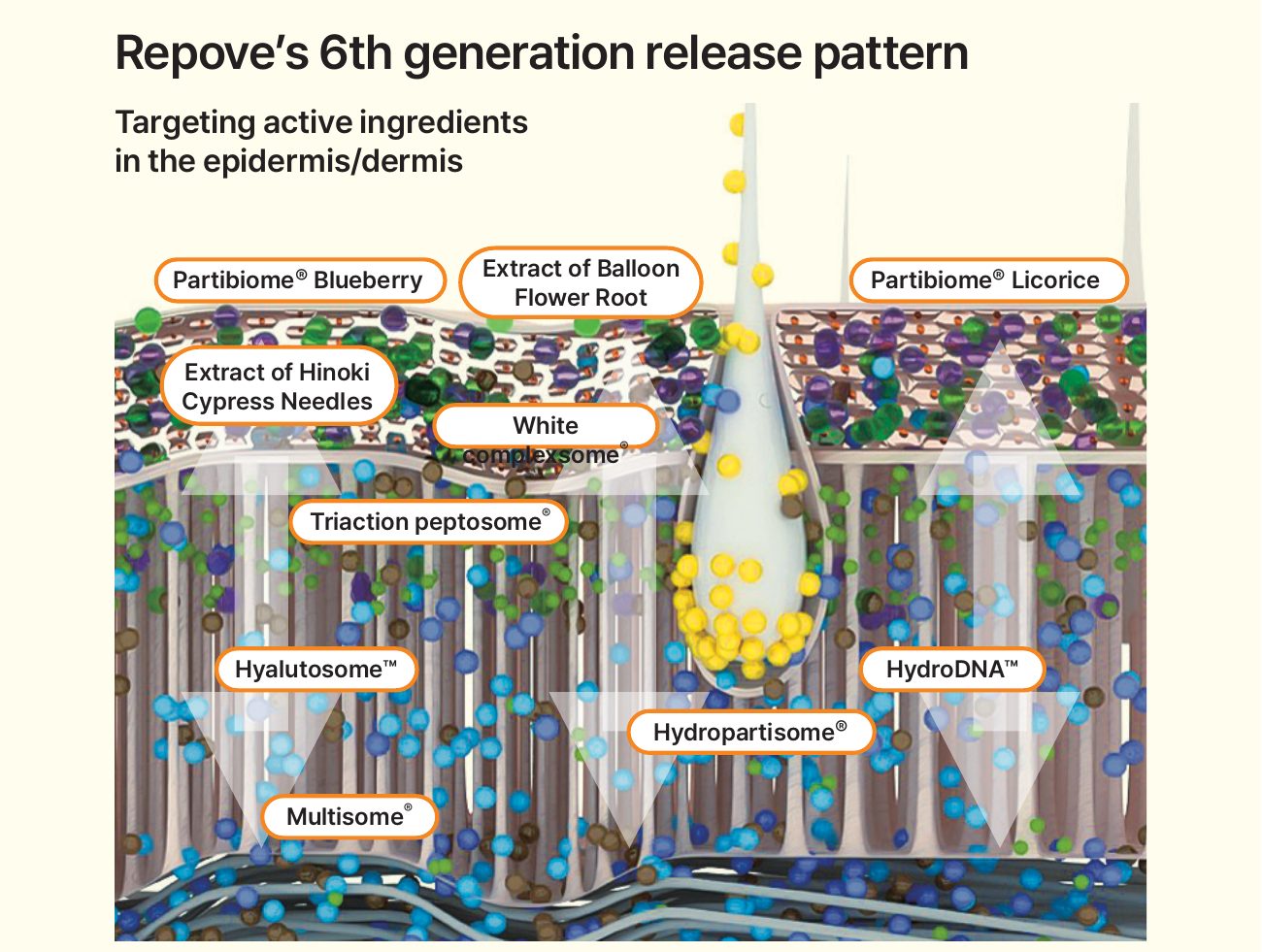
Several derivative carriers have been built on the platform, each tuned to its payload. The specifications published in the company's 2024 English technical catalogue are as follows.
| Carrier | Payload | Particle size · encapsulation | Evidence · IP |
|---|---|---|---|
| HydroDNA™ | Salmon-derived PDRN (Sodium DNA) | ≈ 23 nm · 99.20% encapsulated | KR 10-2678046 · Franz-cell skin absorption test |
| Hyalutosome™ | Low-molecular-weight hyaluronic acid | ≈ 40 nm | KR application 10-2021-0191800 · Franz-cell test |
| Triaction peptosome™ | Three peptides | ≈ 160 nm | Hydroethosome® platform |
| Multisome® Licorice | Licorice root extract (glycyrrhizic acid) | ≈ 120 nm | Co-encapsulation of multiple actives |
| Hydropartisome® | Copper tripeptide and other scalp actives | 200–250 nm solid lipid nanoparticles; follicular route, sustained release | KR 10-2037354 · 10-2190935 · US 11,826,474 B2 |
Two points deserve a buyer's attention. First, PDRN — a DNA fragment whose negative charge makes it notoriously difficult to hold stably in lipid vesicles — is encapsulated at 23 nm with better than 99% efficiency. Second, particle size on the same platform is deliberately varied from 40 nm for hyaluronic acid to 250 nm for follicle-targeted solid lipid particles, according to where the active needs to go.
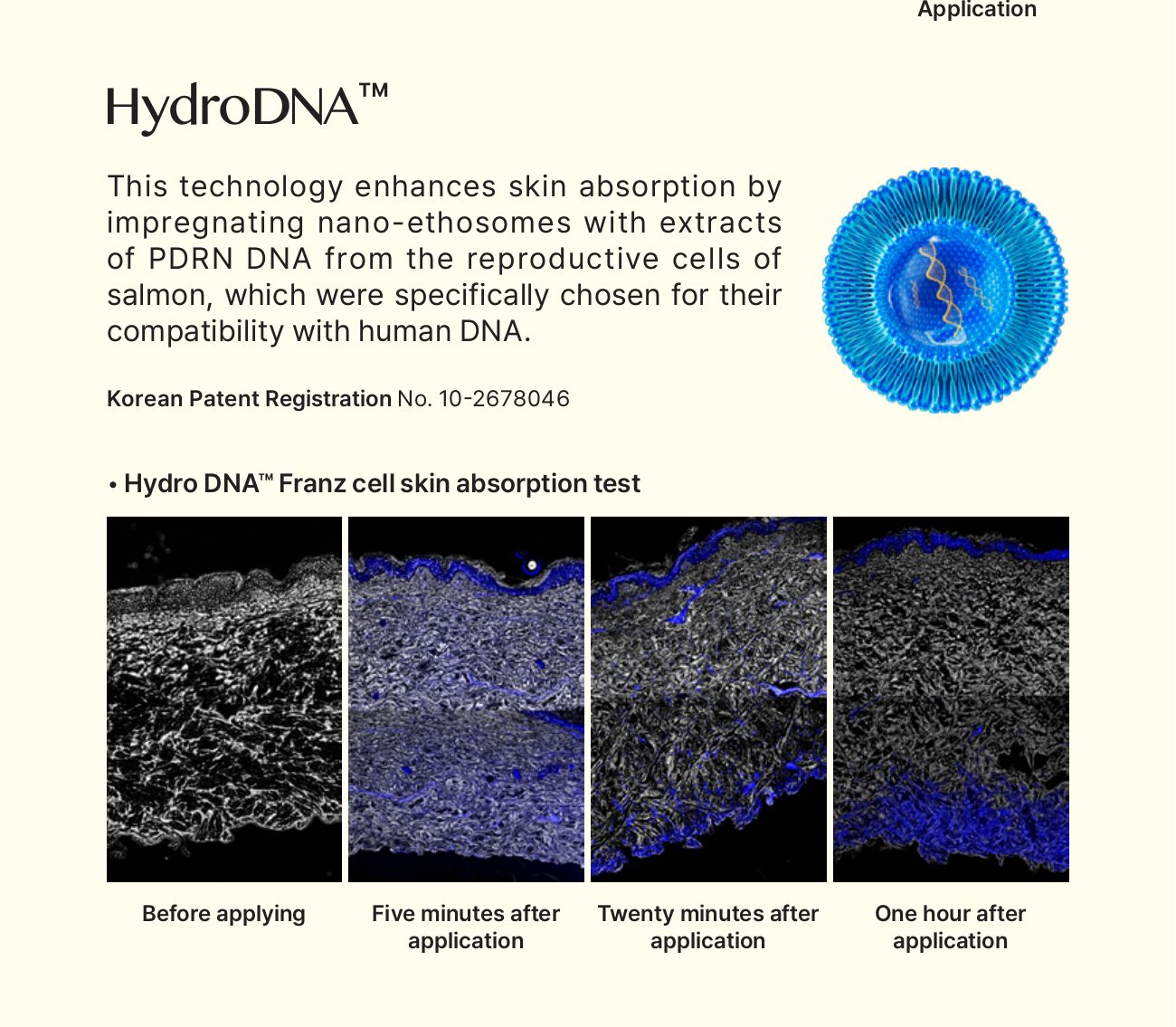
Skin penetration was documented in-house by Franz-cell imaging, and at finished-product level by third-party testing: for REPOVE Solution B, the Korea Institute of Dermatological Sciences measured a 150% increase in skin absorption rate, and 223% increases in absorption speed and depth, 30 minutes after application.
Oral delivery: Absosome™, and numbers measured in people
For ingested actives, Absosome™ coats nano-lipid particles with successive layers of chitosan and poly-glutamic acid, shielding the payload through gastric acid and digestion and assisting uptake in the intestine. This multi-coated nanoparticle technology was granted a US patent in 2025 (US 12,318,462 B2) and a European patent (EP 3995126), validated in Germany, the United Kingdom and France.
Oral-delivery claims are frequently supported only by animal data. Binotec has published a human pharmacokinetic study in a peer-reviewed journal. At the Efficacy Evaluation Center of Jeonbuk National University Hospital, 20 healthy adult men were divided into two groups: one took 400 mg of HYDROCUMIN™, curcumin encapsulated in Absosome™; the other took 2,000 mg of conventional curcumin. Peak plasma concentration (Cmax) was 445.15 versus 38.30, and total exposure (AUC) 2,477 versus 561. With one-fifth of the dose, AUC was 4.4 times higher — roughly 23-fold when normalised to equal dose. The results were published in Scientific Reports in 2026. An earlier animal study reported a 109-fold AUC difference; that result is preclinical.

The company is explicit that these are absorption metrics and do not imply any specific health effect. What an overseas buyer can review alongside the ingredient specification is human data with a named institution, subject numbers, doses and endpoints on the record.
Reading the patent portfolio
| Jurisdiction | Number | Subject | Status |
|---|---|---|---|
| United States | US 11,452,679 B2 | Hydroethosome® transdermal carrier | Granted 27 Sep 2022 |
| United States | US 11,826,474 B2 | Nano-lipid carrier (Hydropartisome® family) | Granted |
| United States | US 12,318,462 B2 | Multi-coated nanoparticles (Absosome™ family) | Granted 2025 |
| Europe | EP 3995126 | Multi-coated nanoparticles | Granted · validated DE / GB / FR |
| Korea | 18 patents | Carrier, fermentation and extraction technologies | Granted |
| International | PCT/KR2018/002808 · TH 1901001249 · DE 11 2018 003 377.5 | Hydroethosome® filings | Pending |
Nano-carriers are not a new idea; the field has developed continuously since liposomes were first described in the 1960s. What Binotec offers as its point of difference is the integration of carrier, fermentation and extraction technologies within one company, linking ingredient development to finished-product manufacture, with the work documented in patents and ten peer-reviewed papers — from a 2019 ethosome transdermal study in the Journal of Drug Delivery Science and Technology to the 2026 human study.
Three routes open to overseas partners
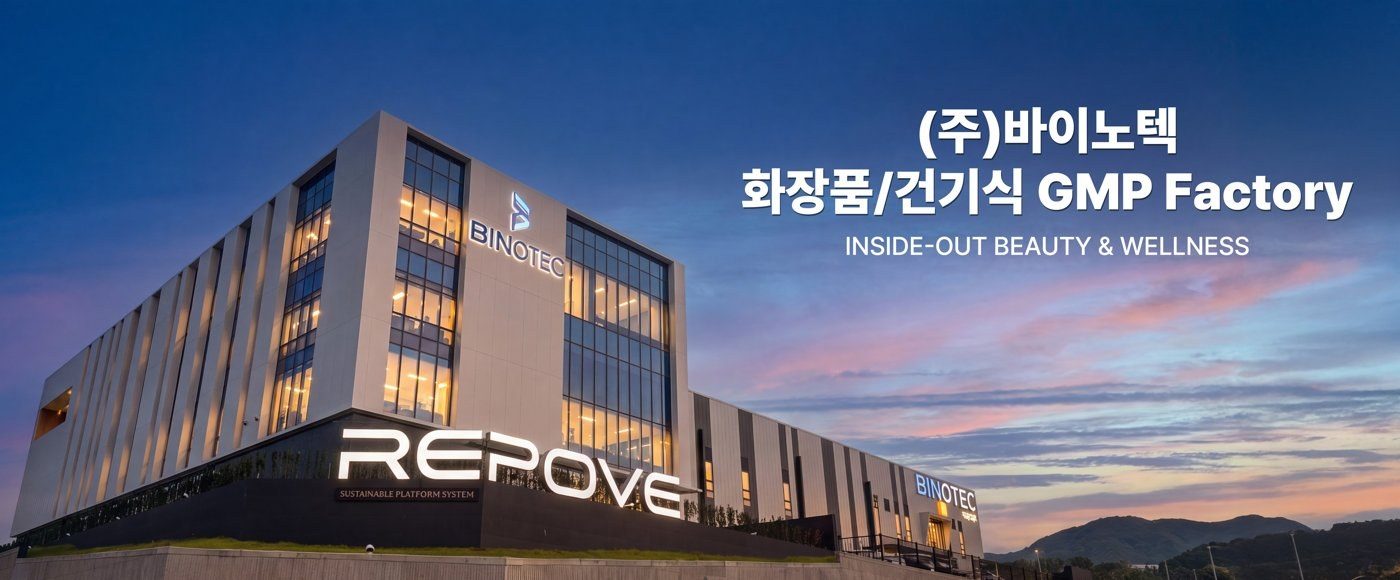
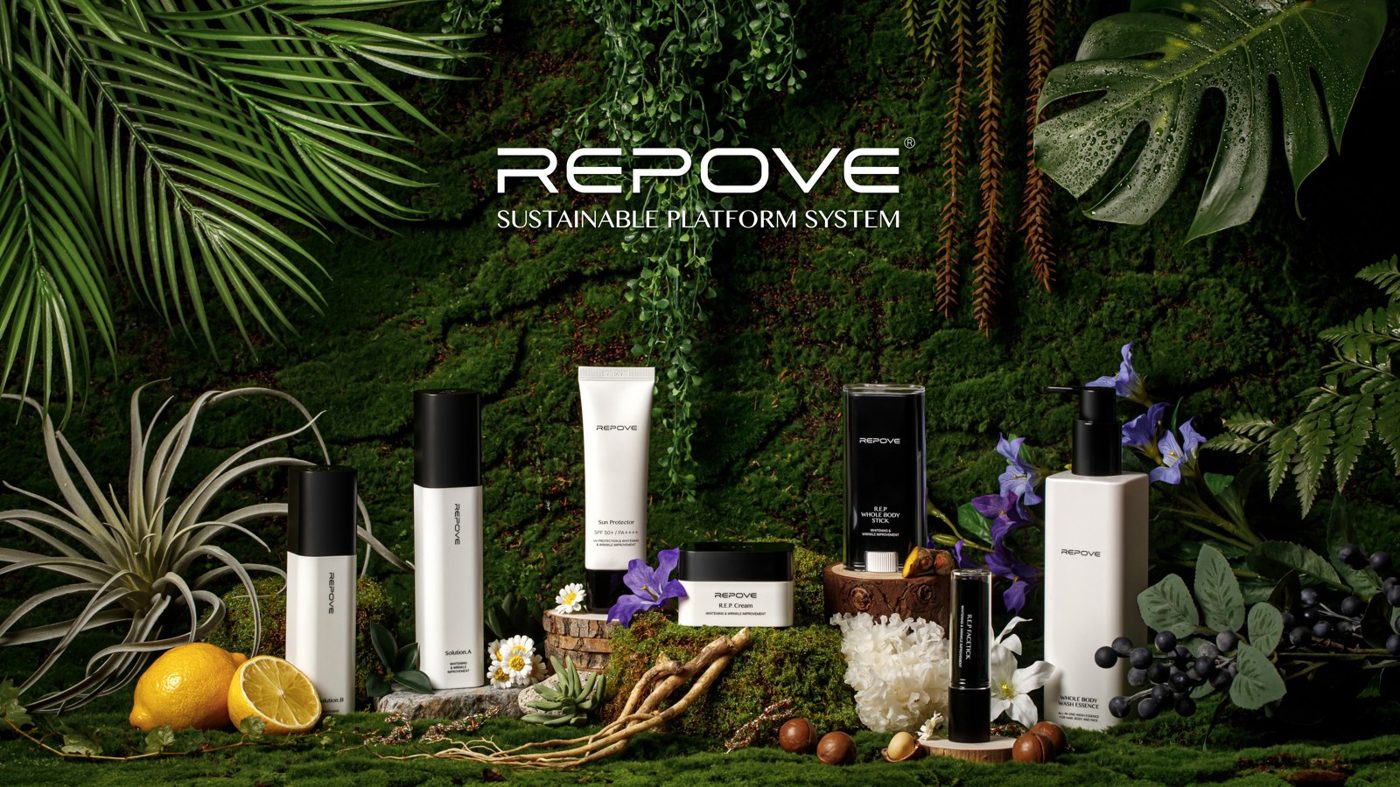
Binotec currently holds 19 cosmetic ingredients and five food ingredients, first deployed in its own skincare brand REPOVE and inner-beauty brand ABSOVE. Three forms of collaboration are open to overseas brands: supply of encapsulated ingredients; joint development in which a partner's own active is encapsulated in a Binotec carrier; and OEM/ODM manufacture at the Gyeongsan plant, which has production history for EU CPNP-notified and MUI Halal-certified products.
"On the strength of technology that can be verified through patents and published papers, we intend to broaden ingredient supply, joint development and manufacturing partnerships with overseas brands," Kim said.
This series introduces Binotec's technologies and products one at a time, in Korean, English and French. The next article follows the Hydroethosome® platform through its sixth generation and the development of HydroDNA™.
About Binotec
Binotec Co., Ltd. is a Daegu-based bio company applying nano-delivery science to cosmetic and food ingredients. Its platforms include the transdermal carrier Hydroethosome®, the oral carrier Absosome™, the fermentation platform Absobiome™ and the high-concentration extraction technology Absotraction™, protected by 18 Korean, three US and one European patent. Binotec was named to Korea's "Innovative Companies 1000" by the Ministry of Science and ICT and received the Minister of SMEs and Startups Award for venture promotion in 2024. It opened a GMP plant in Gyeongsan in September 2026, was an official sponsor of APEC 2025, and exhibited at CES 2026 and Cosmoprof Bologna 2026.
Media contact
In-yeol Ahn, Head of Media Division, FOB Holdings · aninyoul@fobholdings.co.kr · news.fobholdings.co.kr
This article is also available in: 한국어 · English · Français · हिन्दी